
What Is a Cryogenic Liquid Cylinder? An Engineering Guide to CO2 Dewars
In industrial gas handling, transferring and storing cold liquefied gases requires specialized hardware. Plant technicians often refer to these vessels casually as “dewars” or “liquid cylinders,” comparing them to heavy-duty insulated vacuum flasks.
However, answering what is a dewar cylinder from an engineering perspective requires looking deeper into thermodynamics and structural design.
A modern cryogenic liquid cylinder is a DOT-4L or EN 1251 certified transportable pressure vessel. It is engineered to hold cryogenic liquids—such as liquid carbon dioxide (LCO2), liquid nitrogen, or liquid argon—at temperatures far below ambient levels while maintaining an active internal working pressure.
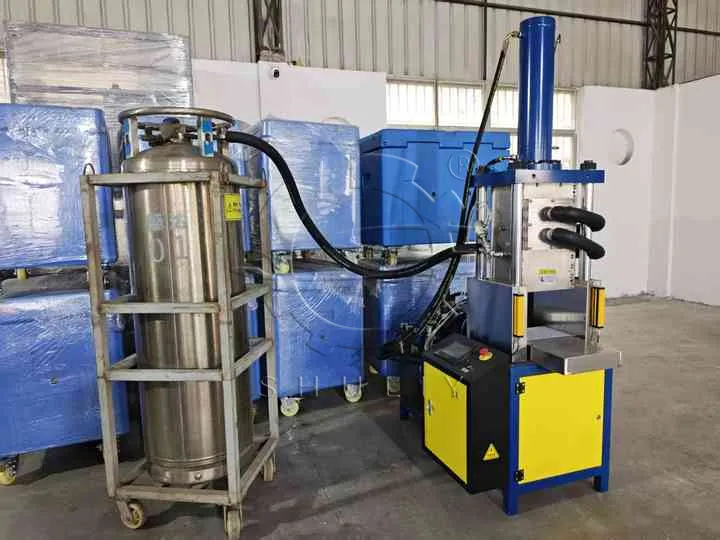
Engineering Inside a Cryogenic Liquid Cylinder: Thermal and Structural Barriers
To keep a subcooled liquid from rapidly boiling into gas, a cryogenic liquid cylinder relies on a double-walled construction separated by an engineered vacuum space.
[Outer Vacuum Jacket (Carbon / 304 SS)]
└── [Annular Vacuum Space: < 10⁻² Pa + Multilayer Foil Wrap]
└── [Inner Pressure Vessel (Austenitic 304 Stainless Steel)] ➔ Liquid CO2 (-20°C, 1.4-2.2 MPa)
The construction of this vacuum insulated cylinder addresses all three methods of heat transfer:
- Conductive Heat Transfer: The inner stainless steel pressure vessel hangs inside the outer shell using non-metallic, low-thermal-conductivity support necks or composite trunnions. Direct metal-to-metal contact between the inner and outer vessels is eliminated.
- Convective Heat Transfer: The annular gap between the two vessels is evacuated to a high vacuum level (typically below 1×10⁻² Pa). With virtually no gas molecules left in this space, heat cannot transfer across the gap via convection.
- Radiant Heat Transfer: The inner shell is wrapped with dozens of alternating layers of reflective aluminum foil and low-conductivity borosilicate fiberglass paper. These radiation shields reflect radiant heat back to the outer wall.
Over years of service, microscopic hydrogen and moisture molecules naturally outgas from the stainless steel. To preserve thermal performance, manufacturers embed chemical “getters” inside the vacuum space to absorb these stray molecules, protecting the thermal barrier without requiring active vacuum pumping.
The Thermodynamic Rule: Why CO2 Dewars Must Maintain Pressure
Operators accustomed to open liquid nitrogen containers often assume all cryogenic vessels work the same way. Liquid nitrogen can sit in an unpressurized container at -196°C, venting freely to the atmosphere. Liquid carbon dioxide behaves completely differently.
Carbon dioxide has no liquid phase at standard atmospheric pressure (1 atm). Its triple point sits at -56.6°C and 5.18 bar (0.52 MPa).
If the internal pressure of a liquid CO2 dewar drops below this 5.18 bar threshold:
- The liquid phase collapses immediately.
- The contents flash violently into solid dry ice snow and cold vapor inside the tank.
- Solid dry ice blocks the internal dip tubes and relief passages, disabling downstream flow.
Because of this physical rule, a cryogenic liquid cylinder designed for CO2 operates as an active pressure vessel. It maintains an operating pressure between 1.4 MPa and 2.2 MPa (14 to 22 bar) with an equilibrium liquid temperature between -20°C and -10°C.
Fluid Mechanics: Liquid Withdrawal vs. Gas Extraction
Industrial processes demand different output states from a supply vessel. A food-packaging flushing line requires warm gas, while a dry ice pelletizer requires pure liquid.
A dual-phase vessel manages these requirements through two distinct extraction circuits:
- Liquid Extraction (Siphon Circuit): The liquid withdrawal valve connects to a stainless steel dip tube (siphon tube) that runs straight down to the lowest sump of the vessel. Driven by head pressure inside the tank, subcooled liquid pushes up through the tube and discharges without gas bubble contamination.
- Gas Extraction: The gas withdrawal valve taps directly into the top vapor space above the liquid line.
- The Pressure-Building Circuit: As liquid exits the tank during fast production runs, the liquid level drops, which can cause internal tank pressure to decline. To counter this, an external finned vaporizer loop mounted beneath the tank draws a small stream of liquid, flashes it to gas using ambient air heat, and feeds that gas back into the top vapor space. This automatic loop holds operating pressure steady without requiring external electrical pumps.
Selecting an industrial liquid CO2 storage tank engineered with matched pressure-building circuits ensures your downstream machinery receives steady liquid flow without line cavitation.
Operational Summary
A cryogenic liquid cylinder is more than a passive storage container. It is an engineered thermodynamic system designed to balance vacuum insulation, structural containment, and automatic pressure maintenance.
Understanding how these vessels preserve liquid phase stability helps plant managers prevent line freeze-ups, eliminate gas venting waste, and ensure a reliable raw material feed for daily production.