
50磅干冰的成本是多少?(以及如何避免浪费金钱)

For small event planners, boutique auto detailers, and local medical clinics, buying 50 lbs (about 22.5 kg) of dry ice is a standard routine. Because the volume is relatively small, business owners often write it off as minor petty cash.

But treating small-batch dry ice as a simple retail expense hides a significant leak in your operating budget. Here is the actual cost of 50 lbs of dry ice in 2026, and why buying small batches is secretly the most expensive way to cool your products.

2026 Prices for a 50 lb Batch

Commercial gas suppliers rarely deliver orders under 100 lbs without charging extreme minimum-order penalties. Therefore, businesses needing 50 lbs are usually forced to pick it up locally.

Here is what you will pay at the register:

Supplier Type每磅价格Total for 50 lbsThe Catch
Grocery / Hardware Store2.00−3.00100.00−150.00Very expensive, often low stock
Local Gas Distributor (Pick-up)1.00−1.5050.00−75.00Requires business hours, manual pick-up

If you pay $60 at the local distributor, it looks like a cheap deal. But the receipt doesn’t show the physical and operational waste attached to small orders.

The Thermal Mass Disadvantage

Sublimation (evaporation) affects all dry ice, but it attacks small batches far more aggressively than bulk pallets. This is due to a lack of thermal mass.

When you pack 500 lbs of dry ice into a massive bin, the blocks insulate each other. The core stays deeply frozen. When you buy a small 50 lb box, almost every piece of ice is near the edge of the container, exposed to the ambient heat.

A 50 lb batch can easily lose 30% to 40% of its weight in just 24 hours. If you buy the ice on Friday afternoon for a Saturday morning cleaning job, your 50 lbs will likely shrink to just 30 lbs overnight.

The Hidden Labor Cost of “Picking It Up”

Because small orders aren’t delivered, you have to send an employee to get it.

Let’s calculate the real cost of a “quick run” to the gas supplier:

  • Your employee spends 45 minutes driving to the supplier, waiting in line, loading the cooler, and driving back.
  • You pay that employee $25 per hour.
  • You spend $5 on truck fuel.

That $60 box of dry ice just cost you an additional $30 in labor and fuel expenses. Your total outlay now stands at $90. You are paying your employees to act as delivery drivers, rather than having them generate revenue inside your store.

The “Over-Ordering” Trap

To compensate for the rapid melting and the drive time, small businesses fall into the over-ordering trap.

If you strictly need 30 lbs of dry ice to pack seafood shipments for the afternoon, you don’t buy 30 lbs. You buy 50 lbs “just in case” some of it melts in the truck. You finish your packaging, and the remaining 15 lbs gets left in a corner of your shop. By Tuesday, the box is empty. You paid for 15 lbs of product that literally vanished into the air.

How to Stop the Waste

The only way to stop wasting money on sublimation, employee drive time, and overime, and over-ordering is to decouple your business from local retail suppliers.

The most efficient solution is using a compact dry ice pellet making machine like the SL-50. Designed specifically for smaller operations, it takes up just 0.5 square meters of floor space.
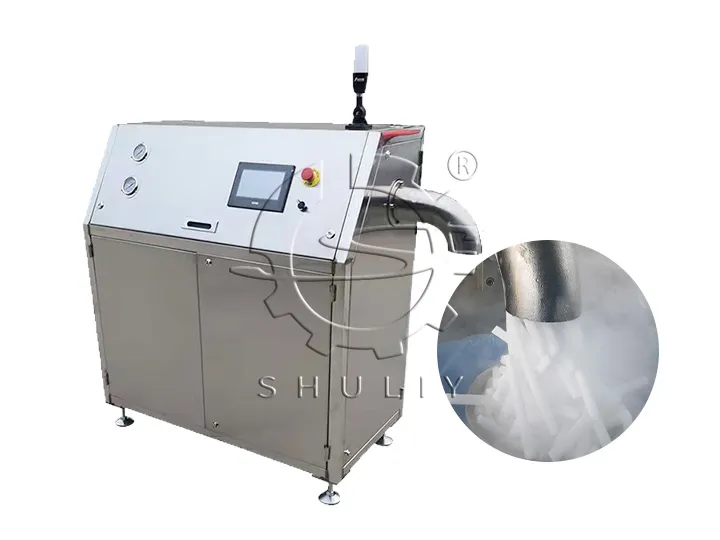
Instead of sending an employee out to buy a 50 lb box, you keep a cylinder of cheap liquid CO2 in your shop.

  • Need exactly 20 lbs for a quick engine detailing job? Turn the machine on, wait a few minutes, and produce exactly 20 lbs.
  • Need 15 lbs to ship a medical cooler? Make exactly 15 lbs.

You eliminate the drive time, you stop paying retail markups, and you never leave unused ice to evaporate in your warehouse again.

类似文章