
Dry Ice Production Line Cost: Engineering & Financial Analysis of Automated Systems
If you supply frozen food, medical goods, or cold chain logistics, you know how expensive it is to buy dry ice from outside suppliers. Liquid carbon dioxide (CO2) is cheap, but finished dry ice blocks are expensive. Making your own dry ice seems like the obvious choice.
However, looking only at machine price tags does not give you the full picture. To understand your true dry ice production line cost, you need to look at how much gas is wasted, how many workers you need, and how much money you can sell the finished ice for.
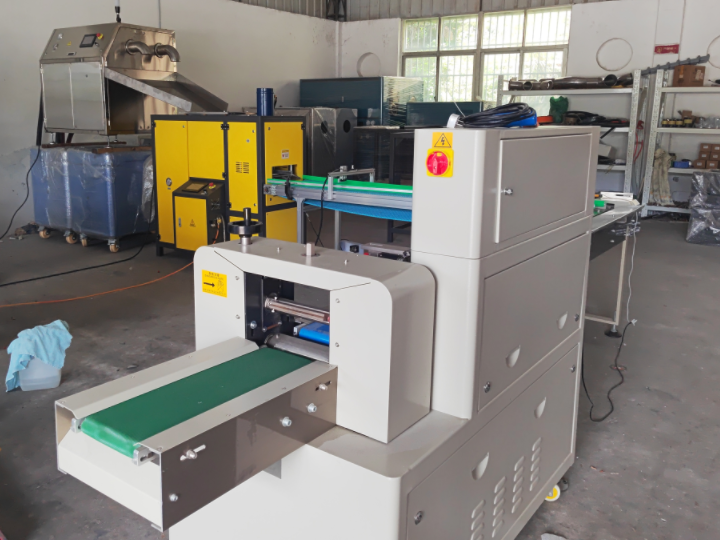
What Really Makes Up Your Dry Ice Production Line Cost?
A basic machine may look cheap at first, but making blocks by hand wastes time and product. A modern, automated production setup connects three simple steps in one continuous flow:
[Liquid CO2 Tank] ➔ [1. Pellet Maker] ➔ [2. Block Press] ➔ [3. Wrapping Machine]
- Making Pellets (200–500 kg/h): Liquid CO2 turns into small, uniform dry ice pellets.
- Pressing Pellets into Blocks: A heavy-duty hydraulic press squashes the loose pellets into tight, solid bricks (125×106 mm).
- Automatic Wrapping: The block slides straight into plastic film, gets sealed, and comes out ready to ship.
Buying an integrated dry ice briquette production and packaging line costs more on day one. But if you make blocks by hand, you pay for extra workers every day, and your ice melts in the open air while waiting to be wrapped.
Stop Wasting Gas: The Key to Low Operating Costs
Liquid CO2 is your biggest daily expense. When liquid CO2 sprays into a machine, roughly half turns into dry ice snow, and the rest turns back into gas.
- Good Machines Keep More Ice: A well-built press turns over 42% to 43.5% of the liquid into solid ice. Cheap machines leak gas, which directly wastes your money.
- Dense Blocks Melt Slower: Loose pellets have too much air between them and melt fast. Pressing them into tight blocks (1450–1550 kg/m3) cuts down surface area, so the ice lasts twice as long.
- Wrapping Locks in Weight: Unwrapped dry ice loses weight every hour from warm room air. Wrapping each block immediately keeps the cold in and stops evaporation during storage.
Cutting Labor with Reliable Electric Parts
Labor and machine breakdowns can quickly double your ongoing dry ice production line cost.
In an older workshop, you need three to four people: one watching the gas tank, one carrying heavy buckets of pellets, and two people wrapping freezing ice by hand.
With an automated line, one person can run the entire shift. The machine automatically moves pellets into the press, shapes the block, and wraps it.
To keep the machine running 24/7 without breakdowns, we use trusted industrial parts:
- Siemens Touch Screen & Brain (PLC): Simple controls that let you change block thickness in seconds.
- Schneider Electric Switches: Protect the main motor from power surges so it does not burn out.
- Omron Relays: Send fast, exact signals between the hydraulic press and wrapper.
Simple Numbers: Payback and Dry Ice Machine ROI
To calculate your dry ice machine ROI, look at what it costs to make one kilogram of wrapped dry ice versus what you can sell it for.
Here is a simple example for a 500 kg/h line running 8 hours a day (4,000 kg per day):
- Liquid CO2 Cost: $0.23 per kg of finished ice
- Electricity & Consumables: $0.03 per kg
- Labor (1 operator): $0.05 per kg
- Total Cost to Produce: ~$0.31 per kg
Profit Comparison: Loose Pellets vs. Wrapped Blocks
| Product Type | Market Price | Profit per kg | Daily Profit (4,000 kg) |
|---|---|---|---|
| Loose Bulk Pellets | $0.55 / kg | $0.24 / kg | $960 / day |
| Wrapped Clean Blocks | $0.85 / kg | $0.54 / kg | $2,160 / day |
Hospitals, airlines, and frozen food companies gladly pay a higher price for clean, individually wrapped blocks because they do not drip water and are clean to touch.
By earning an extra $0.30 per kg, this dry ice equipment investment can easily pay for itself in 6 to 9 months.
The Bottom Line
When you plan for commercial dry ice manufacturing, do not look only at the sticker price of the equipment. Look at how much gas it saves, how few workers it needs, and how much your customers will pay for clean, wrapped blocks.
A fully automated line keeps your daily operating costs low and produces a high-value product that helps you beat the competition from day one.