How Much Does 100 lbs of Dry Ice Cost? (2026 Guide)
If you run an auto detailing shop, a seafood delivery service, or a medical lab, buying dry ice is a constant expense. But looking only at the supplier’s price tag doesn’t tell the whole story.
Here is a straightforward look at what 100 lbs (about 45 kg) of dry ice actually costs in 2026, where your money is leaking, and how to fix it.
The 2026 Price List for 100 lbs of Dry Ice
Prices change based on how much you buy and whether you pick it up or have it delivered.
Here is what you can expect to pay for 100 lbs today:
| How You Buy It | Price Per Pound | Total Cost for 100 lbs | Who Buys This Way |
|---|---|---|---|
| Local Retail (Supermarkets) | 1.50−3.00 | 150.00−300.00 | Individuals, emergency use |
| Wholesale (You Pick It Up) | 0.50−1.00 | 50.00−100.00 | Auto detailing shops, small caterers |
| Wholesale (Delivered) | 0.80−1.20 | 80.00−120.00+ | Labs, large shipping centers |
*Note: Delivery orders usually tack on extra fuel charges and hazardous materials (Hazmat) fees, which can quickly add another $30 to yourbill.*
The “Melting Tax”: Why You Get Less Than You Pay For
Dry ice doesn’t melt into a puddle; it evaporates directly into gas. This means the 100 lbs you paid for at the gas factory is shrinking every minute it sits in a truck or your warehouse.
If a supplier drops off 100 lbs of dry ice on a Friday, and you store it in a standard cooler, you will likely onlyave 70 to 75 lbs left by Monday morning.
The Size Matters: Small 3mm pellets (used for car cleaning) evaporate much faster than thick blocks because more surface area is exposed to the air.
How “Old” Ice Slows Down Your Work
Evaporation doesn’t just steal your money; it ruins the ice.
Fresh dry ice is rock hard. But after a day in storage, it becomes soft and powdery.
- For Cleaning: Powdery ice clogs up dry ice blasting machines. It also doesn’t hit surfaces hard enough to clean tough grease. Your workers end up frustrated, wasting time and compressed air trying to make bad ice work.
- For Shipping: Soft ice won’t stay cold as long, putting your expensive frozen steaks or medical samples at risk during long transit times.
The Smart Fix: Make It Yourself
When a business starts using 100 lbs or more of dry ice every day, buying it in boxes stops making sense. The modern solution is to make it exactly when you need it.
Instead of buying solid ice, you buy bulk liquid CO2, which is cheap (around 0.15to0.15 to 0.15to0.25 per pound) and can sit in a tank for months without evaporating.
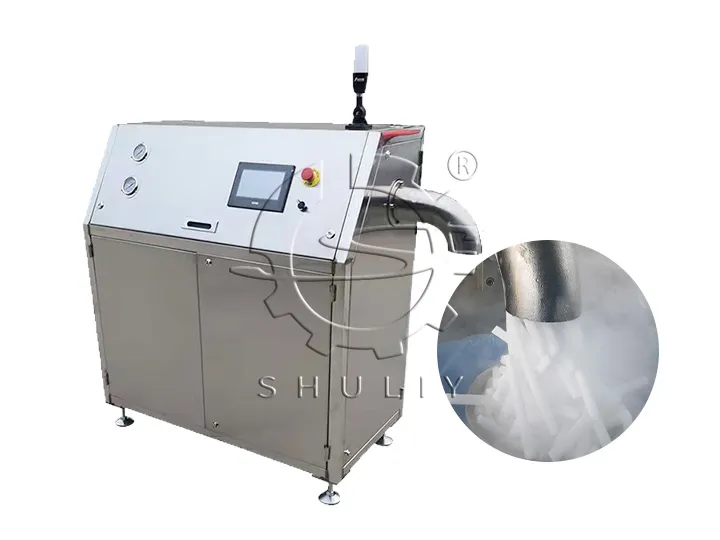
Using an industrial dry ice pellet making machine, you simply turn that liquid into solid ice right on your shop floor.
Let’s do a simple calculation:
- Producing 1 pound of solid dry ice requires approximately 2.4 pounds of liquid carbon dioxide.
- 2.4 lbs × 0.20 (average cost of liquid CO2) = $0.48 per pound.
For roughly $48.00, you can make a fresh 100 lbs of dry ice. You pay zero delivery fees, suffer zero melting loss, and your workers always get perfectly hard, fresh ice to do their jobs efficiently.