
The Real Cost of Dry Ice Pellets Per Pound: Buying vs. Producing In-House
When you audit your business expenses, the line item for dry ice might look straightforward. Your supplier charges you a flat rate per pound, you pay the invoice, and you receive the product.
However, the invoice price is heavily misleading.
If you run an auto detailing shop or a cold chain shipping center, you need to understand the true cost per usable pound. Let’s break down the hard math of buying pre-made dry ice versus producing it in-house.
The Trap of “Delivered” Prices
When purchasing pre-made 3mm or 16mm dry ice pellets, the base price usually sits between 0.80and0.80 and 0.80and1.20 per pound for commercial buyers. But the supplier does not absorb the logistics costs.
Your final invoice typically includes:
- Hazmat Fees: Dry ice is a hazardous material. Shipping it legally requires special handling fees.
- Fuel Surcharges: Heavy insulated containers require truck delivery, adding fluctuating fuel costs.
- Container Rental: You often pay daily rental fees for the insulated totes.
Once you add these hidden fees, a standard 200 lb order at a base price of 1.00/lboftentotals260.00. Your actual starting cost is already $1.30 per pound.
The 25% Shrinkage Rule
The most expensive part of buying dry ice is physics. Dry ice sublimates (evaporates) continuously.
Once these hidden fees are added, a standard 200-pound order with a base price of $1.00 per pound typically totals $260.00. Your actual starting cost is, in reality, already $1.30 per pound.
A standard insulated tote loses about 20% to 25% of its payload in the first 24 hours.
The Real Math:
- You paid $260.00 for 200 lbs.
- You open the box and only find 150 lbs of usable, hard pellets.
- 260.00÷150lbs=1.73 per usable pound.
You are paying $1.73 per pound, and the ice you receive is already softening, which reduces its cooling lifespan and causes jams in pneumatic blasting equipment.
The Math of In-House Production
Companies consuming more than 100 lbs daily are cutting these costs by installing an industrial dry ice pellet making machine directly on their shop floor.
Instead of buying evaporating solid ice, you buy bulk liquid CO2. Liquid CO2 is stored in pressurized tanks and does not evaporate or lose weight over time.
In 2026, bulk commercial liquid CO2 costs roughly 0.15to0.15 to 0.15to0.25 per pound, depending on your region.
A high-quality pelletizer works at a 2.4-to-1 ratio. It takes 2.4 lbs of liquid CO2 to press 1 lb of solid, high-density dry ice. The rest safely flashes back into gas during the extrusion process.
The Production Math:
- 2.4 lbs of liquid CO2 × 0.20/lb=0.48 raw material cost.
- Zero delivery fees.
- Zero sublimation waste (you make it 5 minutes before you use it).
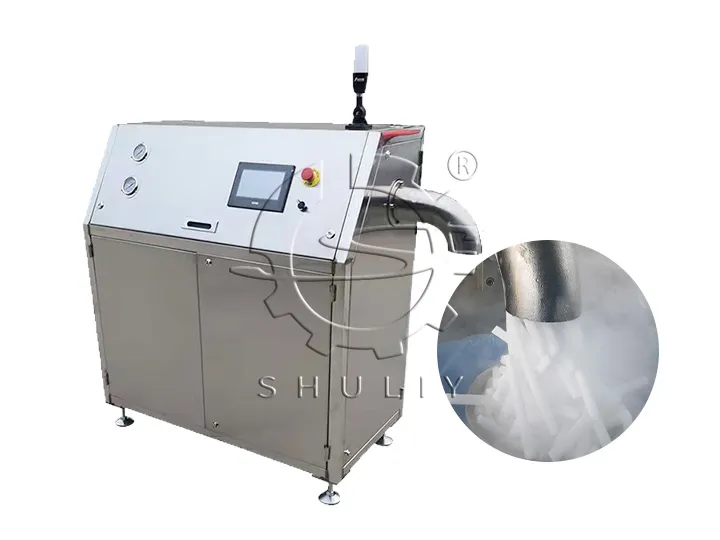
Machine de fabrication de granulés de glace sèche
Buy vs. Make: The Final Breakdown
Here is a direct comparison of your true costs for 150 lbs of usable dry ice:
| Cost Factor | Buying Pre-Made Pellets | Producing In-House |
|---|---|---|
| Base Material | $1.00 / lb | $0.20 / lb (Liquid CO2) |
| Delivery & Hazmat Fees | $60.00 average | $0.00 |
| Lost to Evaporation | 50 lbs (25% loss) | 0 lbs |
| True Cost Per Usable Pound | $1.73 / lb | $0.48 / lb |
| Total Cost for 150 lbs Usable Ice | $260.00 | $72.00 |
By producing your own pellets, you slash your daily dry ice budget by over 70%. The equipment pays for itself rapidly, and your staff always operates with fresh, high-impact ice.